Groundwater depletion in Punjab: what 25 years of satellite data reveal
Punjab grows much of India's grain but is draining its aquifers fast. Here is how Landsat NDVI and NDWI change maps over 2000-2025, paired with groundwater data, expose the stress.
Punjab is one of the most groundwater-stressed regions in India. The short reason is simple: the state grows water-hungry paddy on a large scale, irrigated mostly by tubewells, and the rate at which farmers pump water out is higher than the rate at which rain and canals put it back. Over 2000 to 2025, satellite data from Landsat, read alongside official groundwater records, shows this stress clearly. Vegetation indices like NDVI track the spread and intensity of irrigated cropping, while water indices like NDWI and the falling water table together tell you the aquifers are being drawn down season after season.
This is the focus of my own research on Punjab water indices, which I presented at the 6th Asian Conference on Geography in 2025. Below I explain why the state got here and how satellite time series make the problem visible.
Why Punjab groundwater is under stress
The Green Revolution changed the cropping pattern
From the late 1960s, Punjab became the centre of India's Green Revolution. High yielding wheat and rice varieties, assured procurement, and subsidised inputs pushed farmers toward a fixed wheat-paddy rotation. It worked for national food security. Punjab and neighbouring Haryana still supply a large share of the wheat and rice that goes into the central pool.
The problem is what paddy demands. Rice is transplanted into flooded fields through the hot, dry summer months before the monsoon settles in. That water has to come from somewhere, and in most of central Punjab it comes from the ground.
Tubewells did most of the pumping
Canal coverage in Punjab is uneven, so farmers turned to tubewells. Cheap or free electricity for agricultural pumps made it easy to run them for long hours. Over decades, millions of tubewells across the state have been pulling water from deeper and deeper.
The result is a classic case of abstraction outpacing recharge. In large parts of central Punjab the water table has been dropping steadily for years. Many blocks are officially categorised as over-exploited, meaning yearly extraction exceeds the annual replenishable groundwater. Districts in the rice belt are usually the worst affected.
Why this matters beyond Punjab
When wells deepen, pumping costs rise and water quality can worsen. Farming becomes more expensive and less secure, and a region that feeds much of the country becomes fragile. Understanding the trend is the first step, and this is exactly where satellite data earns its place.
How satellite data exposes the depletion
Groundwater itself sits below the surface, so you cannot see it directly in an optical image. What you can see are the surface signals that go hand in hand with heavy groundwater use: where and how intensely crops grow, and how surface moisture and water bodies change. By stacking these over 25 years, you build a picture that single field visits or one year of data cannot give you.
NDVI: tracking irrigated cropping over time
NDVI, the Normalised Difference Vegetation Index, uses the red and near-infrared bands to measure how green and dense vegetation is. In an irrigated agricultural state, NDVI during the paddy and wheat seasons is a strong proxy for active, well-watered cropping.
Using Landsat imagery, which gives a consistent archive back to the early 2000s and beyond, I built NDVI change maps comparing earlier and later years in the 2000-2025 window. The point of a change map is to highlight where green-up has intensified or expanded. In Punjab, sustained high growing-season NDVI across the central districts is the surface fingerprint of the same intensive paddy cultivation that drives the pumping.
NDWI: reading surface water and moisture
NDWI, the Normalised Difference Water Index, is built to be sensitive to water content, using green and near-infrared bands. It helps flag open water, very wet soils, and flooded fields such as transplanted paddy.
NDWI does not measure the aquifer. What it does is help separate genuinely water-rich surfaces from merely green ones, and it shows how surface water expression shifts across seasons and years. Read together with NDVI, it sharpens the story: intense cropping that depends on irrigation rather than on abundant natural surface water.
The step that ties it together: groundwater data
This is the part that turns interesting maps into a real argument. On their own, NDVI and NDWI describe the surface. To connect that surface behaviour to the aquifer, I paired the Landsat indices with observed groundwater records, the kind of water-level data collected at monitoring wells.
The workflow looks like this:
- Build a consistent Landsat NDVI and NDWI time series across 2000-2025.
- Generate change maps so spatial trends in cropping and surface moisture stand out.
- Overlay the satellite trends against groundwater level trends for the same districts and period.
- Look for where intense, sustained irrigated cropping lines up with declining water tables.
Where heavy growing-season NDVI persists in districts that also show long-term groundwater decline, the link between cropping intensity and aquifer stress becomes hard to dismiss. The satellite record gives you the where and the how widespread, and the groundwater record gives you the depth dimension that imagery cannot.
What 25 years of data tell us
Three things stand out from this kind of long-baseline analysis.
The stress is spatial, not uniform. The central rice-growing belt behaves very differently from the foothill or canal-served margins. Change maps make those internal contrasts visible in a way that state-level averages hide.
The stress is structural. This is not a one-bad-year story. The pattern is tied to a cropping system that has stayed fixed for decades, which is why a 25-year window matters more than any single season.
Free, open data can carry the analysis. The entire Landsat archive is open, and tools like QGIS and Google Earth Engine make multi-year index processing accessible. You do not need expensive commercial imagery to document a problem this size, which matters for research in India where budgets are tight.
Why the long satellite record matters for India
Punjab's situation is a warning for other intensively irrigated parts of India. A reliable, repeatable method, Landsat indices plus groundwater data over a long baseline, gives policymakers and researchers an evidence base for crop diversification, smarter water pricing, and targeted recharge.
For me as a geospatial researcher based in Chandigarh, the most useful takeaway is methodological. When you combine NDVI and NDWI change detection with ground-truth groundwater observations across a quarter century, you move from a vague sense that Punjab is running dry to a defensible, location-specific account of where and why it is happening. That is the kind of clarity satellite data is built to provide.
Frequently asked questions
Why is Punjab's groundwater depleting so fast?
Punjab's fixed wheat-paddy rotation demands heavy irrigation for rice grown mainly through tubewells on cheap electricity, so farmers pump water out faster than rain and canals can replenish it, an abstraction outpacing recharge.
Can satellites directly measure groundwater levels?
No, groundwater sits below the surface and can't be seen directly in an optical image; satellites instead pick up surface signals like crop vigour and moisture that correlate with heavy groundwater use.
How many years of satellite data does this Punjab groundwater study cover?
The study builds a Landsat NDVI and NDWI time series across 2000 to 2025, a 25-year window chosen because the depletion pattern is structural rather than tied to any single bad year.
Do you need expensive commercial satellite imagery to study groundwater depletion in India?
No, the entire Landsat archive is open and free, and tools like QGIS and Google Earth Engine make multi-year index processing accessible without needing costly commercial imagery.
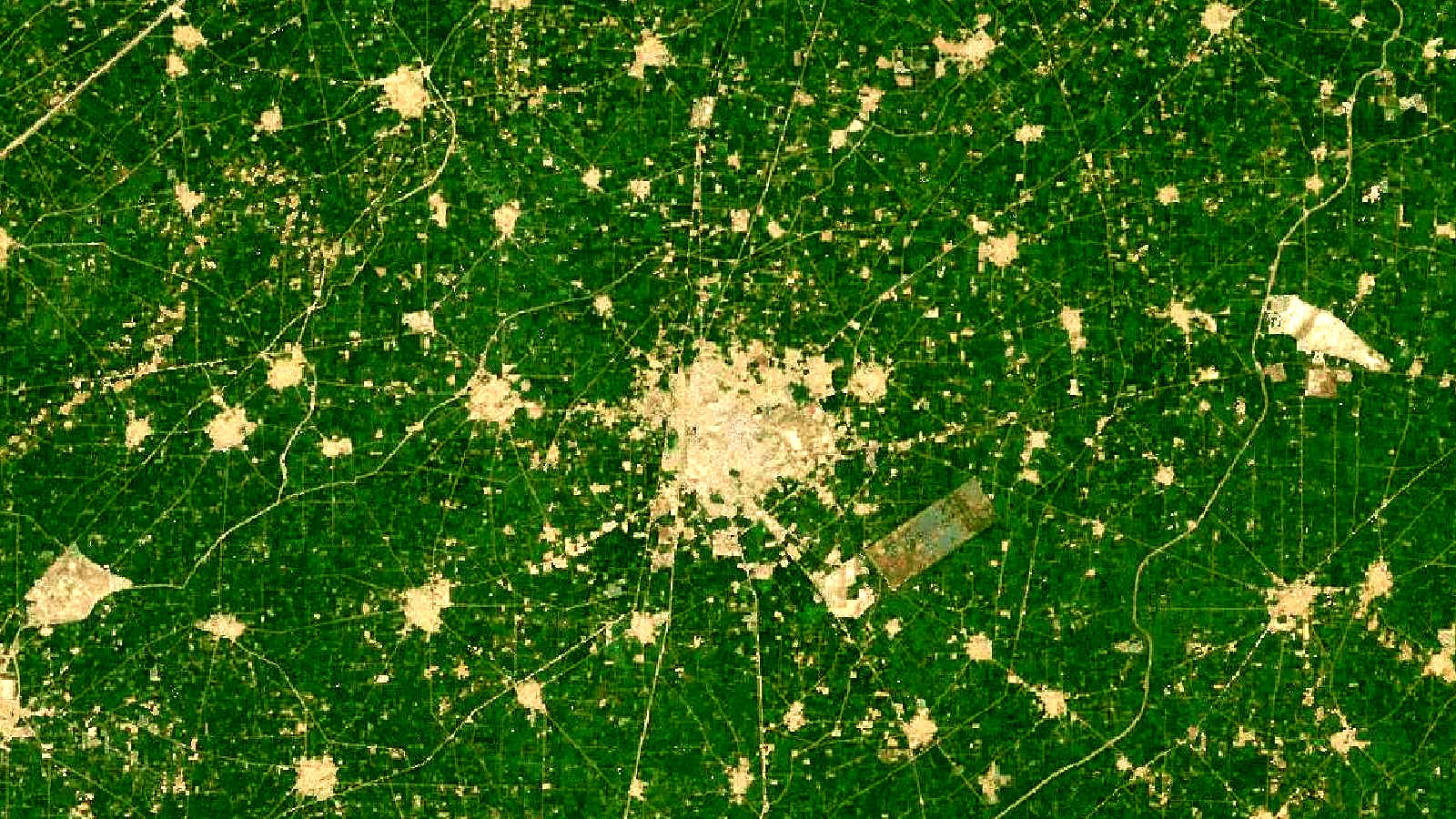
Cover image: Landsat true-colour composite of farmland near Sangrur, Punjab (2000), NASA/USGS Landsat WELD via NASA GIBS (public domain).